
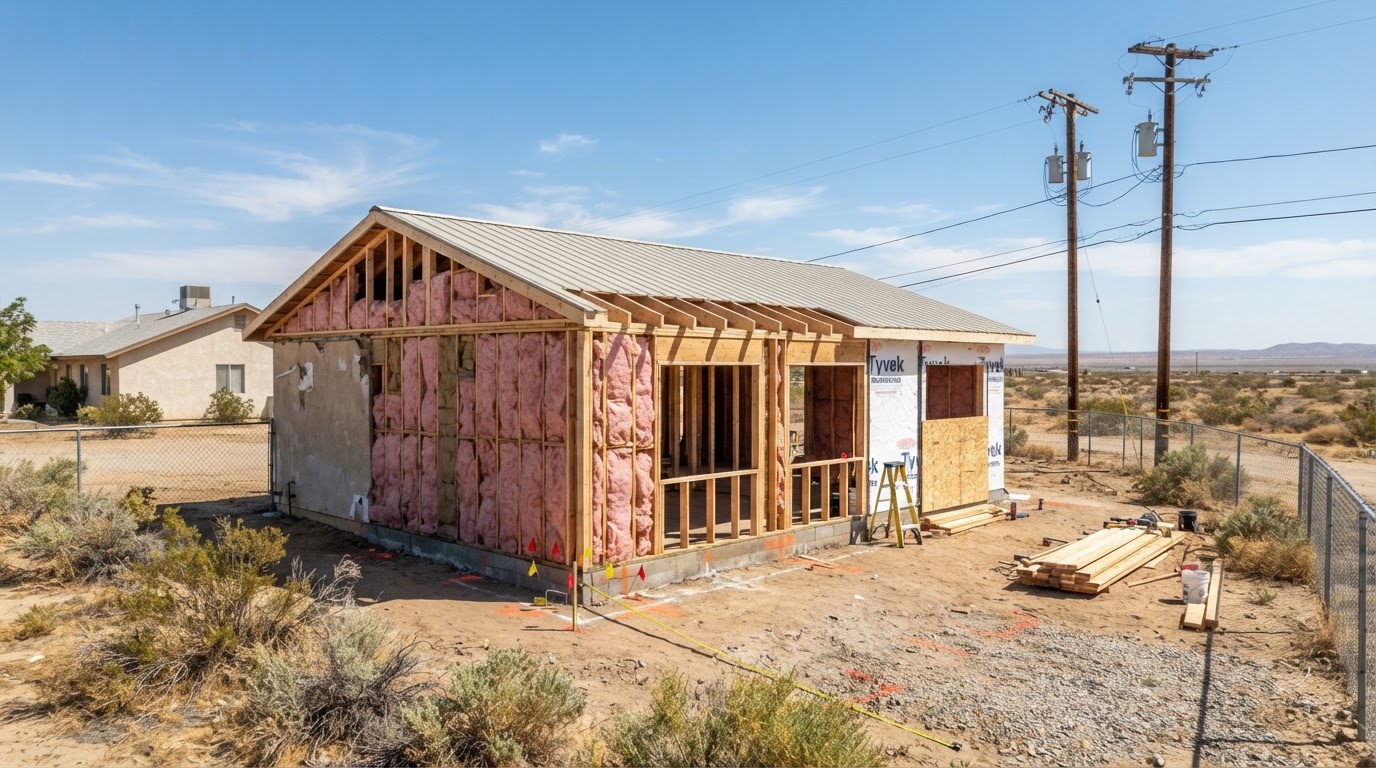
ADU Builders, Design & Garage Conversions in Boron, CA
Boron is an unincorporated desert community in southeastern Kern County, so the permitting authority for parcels here is Kern County — not the City of Bakersfield. Boron lots often hold existing accessory buildings — garages, sheds, or outbuildings — that homeowners consider converting, and a new detached ADU is also an option. But an existing structure doesn't automatically qualify for conversion: its foundation, structure, height, egress, insulation, and utilities all affect whether a conversion is feasible and what corrective work it would require. The desert climate also means energy-efficient design — cooling and insulation — is a defining consideration. We plan each Boron ADU around the actual lot — its existing structures, its site feasibility, its utility situation, and its foundation conditions — confirm Kern County's current requirements for your parcel, and coordinate the design and permit path together.
ADU Construction & Accessory Conversions in Boron
Boron is an unincorporated desert community in southeastern Kern County, so ADUs here are permitted through Kern County, not the City of Bakersfield. Boron lots often hold existing accessory buildings — garages, sheds, or outbuildings — that homeowners consider converting, and a new detached ADU is also an option.
But an existing structure doesn't automatically qualify for conversion: its foundation, structure, height, egress, insulation, and utilities all affect whether a conversion is feasible and what corrective work it would require. The desert climate also means energy-efficient design — cooling and insulation — is a defining consideration.
Accessory-Building Conversion Considerations
Whether an existing Boron structure can be converted depends on its actual condition — not on assumptions about the building.
Existing-structure condition
An existing garage, shed, or outbuilding must be assessed for foundation, structure, height, egress, insulation, and utilities before a conversion is feasible. Some Boron buildings can be converted with corrective work; others cannot.
Corrective scope
A desert conversion often needs substantial insulation and HVAC upgrades to meet current energy standards. The corrective scope is confirmed by an existing-condition assessment, not assumed from the building alone.
New detached ADU
Where a conversion isn't feasible or doesn't fit your goals, a new detached ADU is also an option, coordinated with your lot's site conditions, utilities, and the County's current standards.
Site feasibility
Buildable area, setbacks, soil, drainage, and utility availability all govern what's feasible on a Boron lot. A parcel-specific evaluation confirms these rather than assuming conditions from the community.
Site Feasibility
Buildable area, setbacks, soil, drainage, utility availability, and the condition of any existing structure all govern what's feasible on a Boron lot. A parcel-specific evaluation confirms these rather than assuming conditions from the community.
Whether a conversion or a new detached unit fits, where it sits, and what site work it needs are confirmed by a parcel-specific review — not assumed from the building alone.
Energy-Efficient Design
Cooling efficiency and insulation are designed up front to the applicable energy standards to manage the desert heat load. Insulation, air sealing, the building envelope, and HVAC sizing are coordinated with the envelope design.
These are confirmed by a parcel-specific evaluation rather than assumed community-wide. Energy documentation (Title 24) reflects the cooling and insulation design, coordinated with the Kern County permit path.
Permitting Jurisdiction: Kern County
Boron is an unincorporated Kern County community, so Kern County is generally the permitting authority — not the City of Bakersfield. We confirm your parcel is in unincorporated Kern County and verify the County's current standards before any plans are prepared.
The County's adopted standards apply alongside current California ADU law. We coordinate the Kern County permit path for your project and verify current requirements with the County before presenting a plan.
The Boron ADU Process — Stage by Stage
A typical path from a desert-lot feasibility review to a permitted, inspected unit, coordinated with Kern County. Your Boron project's actual steps depend on your lot, any existing structure, and the County's current requirements.
Consultation & Project Goals
Share your goals for the unit and your Boron property's basics, including any existing accessory building and your utility situation. We shape the design around what your desert lot supports and what you want the unit for.
Key considerations
- Intended use and occupant
- Existing structure condition and utility situation
- Cooling and insulation priorities
Stage outcome: A clear understanding of your goals and the likely scope for your Boron lot.
Site Feasibility & Existing Conditions
We review your lot's buildable area, setbacks, soil and drainage, utility availability, and the condition of any existing structure. We confirm your parcel is in unincorporated Kern County and verify the County's current standards.
Key considerations
- Buildable area, setbacks, and soil
- Existing structure condition
- Utility availability and desert site conditions
Stage outcome: A feasibility findings summary and a configuration recommendation for your Boron parcel.
Design & Engineering Coordination
The ADU is designed to your lot's site conditions and desert-climate energy requirements, with structural, energy (Title 24), and utility documentation coordinated where applicable. Cooling and insulation are designed up front to the applicable energy standards.
Key considerations
- Conversion or new-build configuration
- Structural and energy documentation
- Insulation and HVAC design
Stage outcome: A coordinated design and engineering package ready for permit preparation.
Permit Preparation & Review
We assemble the Kern County permit set and submit it for review. The County may issue review comments or request corrections; revised drawings are resubmitted until the plans meet current code. No timeline or approval is guaranteed.
Key considerations
- Kern County submittal requirements
- Review comments and corrections
- No guaranteed approval or timeline
Stage outcome: An approved permit set ready for construction on your Boron lot.
Construction & Trade Coordination
Once permitted, construction proceeds — foundation, framing, systems, and enclosure — with trades sequenced around the County's inspection schedule. Desert site conditions can shape the construction sequence on some lots.
Key considerations
- Inspections at each construction stage
- Trade sequencing around inspections
- Corrections where an inspection identifies issues
Stage outcome: A built ADU progressing through required inspections.
Inspections & Completion
Final inspections — electrical, plumbing, mechanical, energy, and a final building inspection — must pass before a certificate of occupancy is issued. Occupancy follows the County's acceptance of the final inspection, not a date we set.
Key considerations
- Final trade and building inspections
- Corrections where required
- Certificate of occupancy
Stage outcome: A permitted, inspected Boron ADU ready for occupancy once the County accepts the final inspection.
Before You Build: A Boron ADU Checklist
Gather this information before your consultation so the design reflects your actual Boron lot — any existing structure, its condition, and your utility situation.
- Confirm your parcel is in unincorporated Kern County
- Document any existing garage, shed, or outbuilding you want to convert
- Check your lot's buildable area, setbacks, and soil
- Verify your utility availability and capacity
- Note any known drainage or desert site conditions
- Define the unit's intended use and occupant
- Gather any prior survey, plans, or permit history
Nearby Service Areas
Adjacent communities we also serve with the same design-build ADU coordination.
Official Permitting & Planning References
Permitting authority and requirements vary by jurisdiction. Confirm current requirements with the applicable agency before relying on this guide for your project.
- Kern County — Is My Address in Unincorporated Kern?A community name or mailing address does not decide jurisdiction — confirm your parcel is in unincorporated Kern County before applying any permitting rules.
- Kern County Public Works — Building & DevelopmentBuilding permits and inspections for unincorporated Kern County desert and mountain-pass communities such as Frazier Park, Pine Mountain Club, Lebec, Mojave, Rosamond, Boron, Lost Hills, and Greenfield.
- CAL FIRE — Fire Hazard Severity Zone MapsFire-hazard severity is assigned by parcel, not by community — confirm whether your parcel is in a designated zone and what construction standards apply before designing.
- California HCD — ADU Handbook (March 2026)Statewide ADU rules that apply alongside Kern County's local requirements.
Information last reviewed November 16, 2026. Verify current requirements with the issuing agency before proceeding.
This page is educational and is not legal or regulatory advice. Eligibility, fees, timelines, and approvals are confirmed for your specific property and jurisdiction. Request an ADU estimate to discuss your project.
Boron ADU — Frequently Asked Questions
Clear, qualified answers for homeowners in this Kern County community. Requirements vary by parcel and jurisdiction, so confirm specifics for your property.
Request a Boron ADU Estimate
Tell us about your Boron property — any existing accessory building, its condition, and your utility situation — and what you want the unit for. We coordinate the feasibility, design, and Kern County permitting your parcel requires.
Confidential project inquiry. We respect your privacy and will never share your information. No SMS automation is active.
Planning an ADU or Accessory Conversion in Boron?
Existing-structure condition, site feasibility, and energy-efficient design all shape a Boron ADU — and all are parcel-specific. Share your property details to start a plan coordinated with Kern County.